Profiles · Officials · Federal Reserve
- Type
- Person
- Role
- Official · Federal Reserve
- Updated
The profile
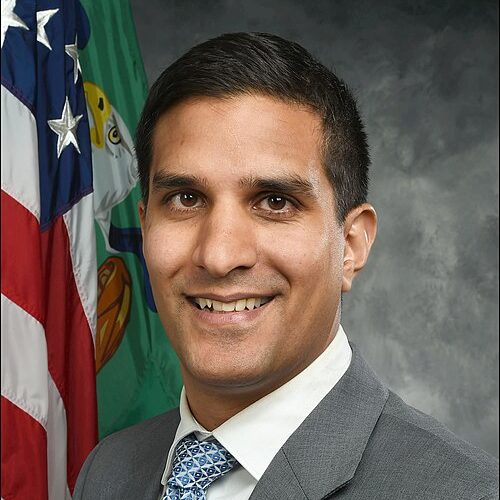
Head of the New York Fed's Markets Group from February 2020 to February 2021, when it ran the Fed's corporate-bond buying; later deputy national security adviser in the Biden White House.
Identity and role
Daleep Singh joined the Federal Reserve Bank of New York in February 2020 as head of its Markets Group and a member of its executive committee, a month before the Fed began launching emergency facilities. The Congressional Oversight Commission identified him in July 2020 as an executive vice president of the bank. He left in mid-February 2021 to join the Biden administration as deputy national security adviser and deputy director of the National Economic Council.
Biography / career arc
Singh began his career at Goldman Sachs and Element Capital, according to his Dallas Fed biography. From 2011 to 2017 he worked at the Treasury Department, where he was acting assistant secretary for financial markets and deputy assistant secretary for international affairs. He was then senior partner and chief U.S. economist at SPX Capital, a global investment firm, before the New York Fed hired him. He has a bachelor's degree from Duke University and graduate degrees from MIT and Harvard.
Pandemic-relief / PPP-EIDL role
The Dallas Fed biography says Singh "led the implementation for most of the Fed's emergency facilities launched during the COVID-19 pandemic." When he resigned, New York Fed president John C. Williams said Singh had "played a critical leadership role in the emergency facilities the Fed launched in response to COVID-19."
The Board's April 9, 2020 announcement shows the scale: up to $2.3 trillion in loans. It covered a Paycheck Protection Program Liquidity Facility that lent to banks against PPP loans at face value, up to $600 billion of Main Street loans and a $500 billion Municipal Liquidity Facility. The two corporate credit facilities and the Term Asset-Backed Securities Loan Facility would support up to $850 billion, backed by $85 billion of Treasury credit protection.
Two of them bought corporate debt. The Primary Market Corporate Credit Facility bought new bonds and loans; the Secondary Market Corporate Credit Facility bought bonds and bond ETFs already trading. Treasury said it would put $75 billion of CARES Act money into them as equity, enough to support up to $750 billion of purchases. By July 15, 2020 Treasury had put in $37.5 billion. The secondary facility had bought $11.4 billion of ETFs and bonds, including more than 500 individual bonds from more than 300 issuers. The primary facility, open since June 29, had not reported a purchase.
Singh explained the slowdown in a July 8, 2020 speech that the Oversight Commission quoted at length. Buying had fallen "from about $300 million per day to a bit under $200 million a day." At the peak, he said, "$300 million of ETF purchases a day represented about 10 percent of average daily volumes." The lower pace was "around 5 percent of the average daily volume of eligible cash bonds, and less than 1 percent of ETF average daily volume." And the facilities might stop buying altogether: "This would not be a signal that the SMCCF's doors were closed, but rather that markets are functioning well."
Purchases through mid-July came to about 1.5 percent of the $750 billion the two facilities could support.
Their own relief
No PPP or EIDL loan, grant or other pandemic-relief payment to Singh personally, or to a company he controls, appears in the New York Fed, Dallas Fed or Oversight Commission documents cited here.
Legal status / controversies
Singh has not been charged with a crime, and no enforcement action or oversight finding names him in the New York Fed, Dallas Fed, Federal Reserve Board or Oversight Commission documents cited here.
Where they are now (2025–2026)
The Dallas Fed lists Singh as a member of its Financial Sector Advisory Council and as vice chair and chief global economist at PGIM, an asset manager with almost $1.5 trillion under management. In the White House he led much of the administration's work where economic policy met national security and represented the United States as sherpa to the G7, G20 and APEC.
Sources held in this archive
Related articles
- Section 13(3) and the Fed Balance Sheet
- The Federal Reserve and Pandemic Relief: An FAQ
Sources
- Federal Reserve Bank of New York, "Daleep Singh Resigns from the New York Fed" (February 5, 2021) — original: https://www.newyorkfed.org/newsevents/news/aboutthefed/2021/20210205
- Federal Reserve Bank of Dallas, Financial Sector Advisory Council biography of Daleep Singh — original: https://www.dallasfed.org/fed/councils/finsector/singh
- Federal Reserve Board, "Federal Reserve takes additional actions to provide up to $2.3 trillion in loans to support the economy" (April 9, 2020) — original: Federal Reserve, April 9, 2020 PPPLF announcement (original: federalreserve.gov · stored capture)
- Congressional Oversight Commission, "The Third Report of the Congressional Oversight Commission" (July 20, 2020) — original: https://fraser.stlouisfed.org/files/docs/historical/cpt/coc/COC_3rdReport_20200720.pdf